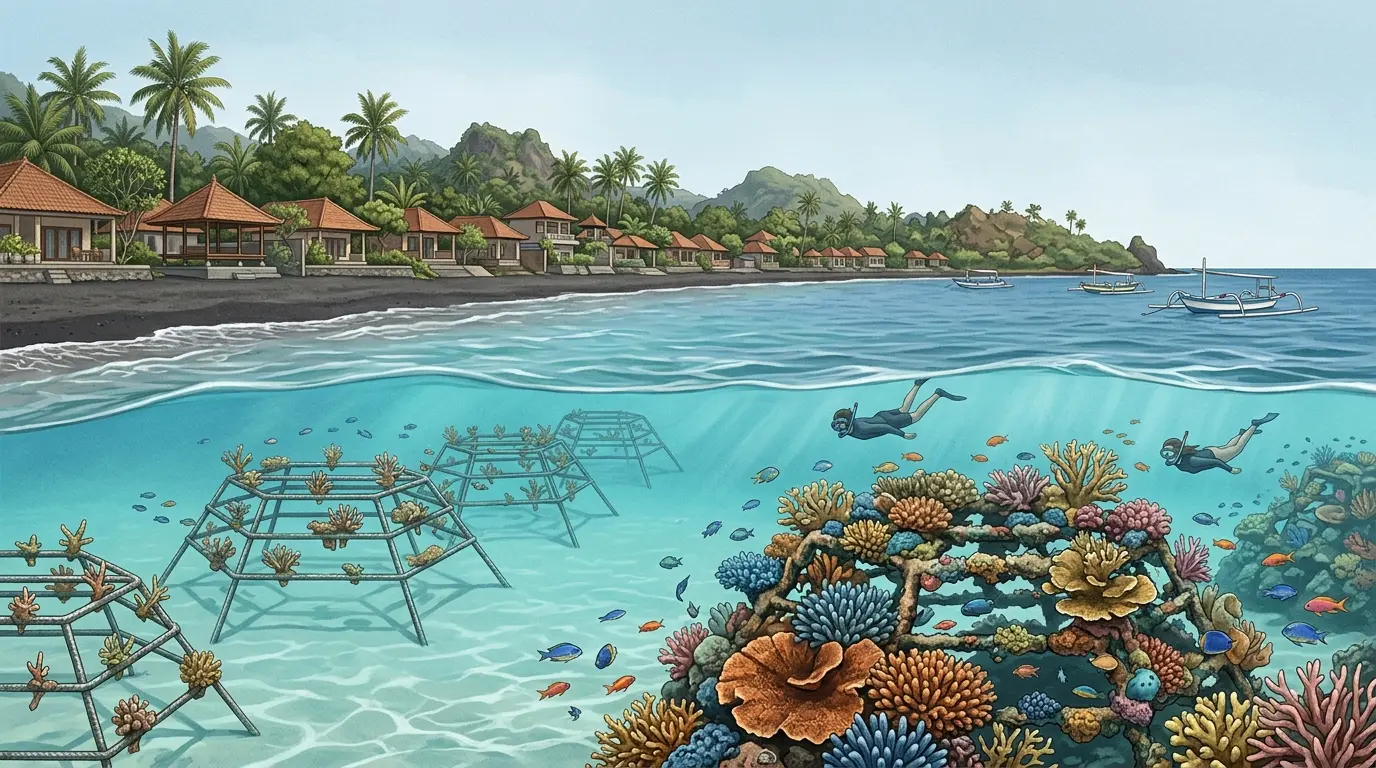
On Bali’s northwest coast, far from the beach clubs of Canggu and the surf crowds of Uluwatu, sits a small fishing village most tourists have never heard of. There are no nightclubs here, no rooftop bars, no traffic. Just a quiet stretch of black-sand coastline, a handful of low-key dive resorts, and — just offshore, in a few meters of water — one of the most remarkable coral reef restoration projects on the planet.
This is Pemuteran, and it’s home to Biorock: a technology that uses electricity to grow coral reefs faster than nature does on its own.
A Village That Rebuilt Its Own Reef
Pemuteran wasn’t always a conservation success story. Back in the 1990s, the reefs here were badly damaged by destructive fishing practices — including blast fishing, which uses explosives to stun and kill fish, destroying entire coral colonies in the process. Fish stocks collapsed, and the fledgling local tourism industry took a hit right along with them.
Rather than watch the reef disappear, the local community made an unusual decision: they partnered with dive operators, resort owners, and international marine scientists to try something experimental. In the year 2000, the Karang Lestari Foundation began installing the very first Biorock structures in Pemuteran Bay — and what started as a small pilot project has since grown into the largest coral reef restoration effort of its kind anywhere in the world.
So, What Exactly Is Biorock?
The science behind Biorock sounds almost too simple to work. Submerged steel frames — usually built from rebar or wire mesh — are connected to a low-voltage electrical current, powered from the shore or, in some setups, by solar panels. That current triggers an electrochemical reaction in the seawater, causing dissolved minerals to crystallize onto the metal structure as a limestone-like coating.
Once that mineral layer forms, small coral fragments are attached to the structure. Backed by the electrical current, those corals grow noticeably faster than corals on a natural reef — some studies suggest as much as three to five times the normal rate — and they tend to hold up better against bleaching events and other environmental stress.
Over the years, the metal frames themselves gradually disappear under new coral growth, until what’s left looks like any other coral reef. Walk along the shallow water off Pemuteran today and you’ll see structures at every stage of that process: some barely a year old and still bare, others decades in and completely alive with color.
Why It’s Worth Visiting
Pemuteran’s Biorock reef sits just a short swim from the shore, usually somewhere between 3 and 7 meters deep — shallow enough for snorkelers, easy enough for beginner divers, and close enough that you don’t need a boat to reach it. That accessibility is part of what makes it such an unusual attraction: most of Bali’s best reef life requires a long boat ride to reach. Here, you can walk in from the beach.
Underwater, the structures form an almost trail-like path through the bay, with dozens of individual reef installations to swim between. Expect to see healthy coral cover, clouds of reef fish drawn to the oxygen-rich water around the structures, and the occasional turtle cruising past. It’s not uncommon for visitors to say the restoration project itself — not just the diving — is the main reason they came to Pemuteran in the first place.
Beyond the Reef
Pemuteran is also the closest and most convenient base for visiting Menjangan Island, the protected snorkeling and diving site inside West Bali National Park, just a short boat ride away. Many travelers use Pemuteran as their overnight base and combine both destinations into a single, slower-paced trip to North Bali — a world away from the pace of the island’s south.
Outside the water, the village itself is worth exploring: quiet warungs, small family-run guesthouses, and a noticeably different rhythm of life compared to Bali’s more touristed regions. It’s a place built around fishing and, now, conservation — not around tourism infrastructure.
Getting to Pemuteran
Pemuteran sits roughly 3 to 4 hours by car from the main tourist hubs of Seminyak, Ubud, or Kuta, making it a long day trip or, better, an overnight stop on a longer North Bali itinerary. Most travelers hire a private car and driver for the journey, and many combine the trip with a stop at Banjar Hot Springs or a visit to Menjangan Island along the way.
Once you’re there, the reef itself is easy to reach — many dive shops and resorts sit right on the bay, with the Biorock structures visible just meters from the beach.
Tips for Visiting Responsibly
Because Pemuteran’s reef recovery has taken decades of community effort, a little extra care goes a long way:
- Avoid touching or standing on any of the structures, even the ones that already look like natural coral
- Use reef-safe sunscreen rather than standard sunscreen, which can harm coral over time
- Book snorkeling or diving trips through local operators connected to the reef conservation effort — many contribute directly to funding new structures
- Bring reusable water bottles and avoid single-use plastics on the beach
What to Pack
A day in Pemuteran usually means long stretches near or in the water, plus a fair amount of walking along the beach and shallow reef trail:
- Reef-safe sunscreen and a rash guard
- Your own snorkel mask, if you have one
- A waterproof dry bag for your phone and camera — useful both on the beach and if you’re combining Pemuteran with a boat trip out to Menjangan Island
- Comfortable water shoes, since parts of the shallow reef area can have loose rock and rubble
Final Thoughts
Pemuteran isn’t a destination that tries to impress you right away. There’s no dramatic viewpoint, no famous temple, no Instagram-famous swing. What it offers instead is quieter and, in its own way, more remarkable: proof that a small fishing village, faced with a dying reef, decided to rebuild it themselves — one electrified structure at a time. For travelers who want to see a different side of Bali, both above and below the water, it’s hard to find a more genuine story than this one.